Adults are presumed capable of making their own decisions, unless reasonable grounds exist to believe otherwise. DecisionTracker™ helps professionals identify those reasonable grounds by screening for risk factors, corroborating information, and monitoring changes over time.
It’s not a capacity assessment tool. It is a proactive safeguard that empowers you to act responsibly without overstepping your role.
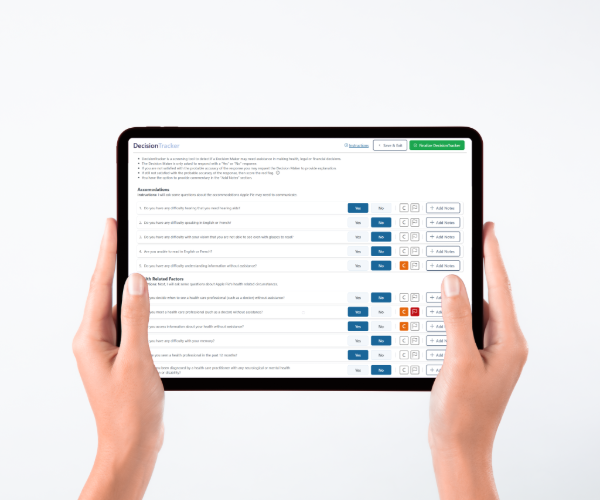
Canada's first evidence-based screening platform
Unlike traditional tools, DecisionTracker™ uses a structured method to cross-check the adult’s understanding with trusted informants. If contradicting information arises during the screening process, the adult is asked to address and explain the contradiction.
If the adult cannot recognize that a conflict exists, or attempts to justify the contradiction but their reasoning is incoherent, this response could be considered a red flag. Conversely, the ability to acknowledge the conflict and provide a logical explanation is generally a positive sign.
This corroborative method provides a clear picture to identify risk and helps professionals take action appropriately and confidently.


By Canadian law and ethical standards, adults are presumed capable of making their own decisions unless Reasonable Grounds exist to suggest otherwise.
Reasonable grounds exist when a person lacks the ability to understand key information about their circumstances. An adult will have increased risk of being incapable and needing further assessment if they are not aware of the:
Risk factors that may indicate a loss or decline of capacity, derived from the adult's response to the DecisionTracker™ questions or contradictions. Trained DecisionTracker™ users will be able to appropriately identify Red Flags and effectively document the context. This will create a clear record for escalation and demonstrate due diligence for compliance and liability protection.
There are two important parts that make DecisionTracker™ highly effective and help build the trust between the adult and the person using it.
When a person is incapable of making decisions and at risk of harm, the adult may not agree to participate in the DecisionTracker™ screening. You and the adult must agree on what should occur in this situation while they are capable.
During the DecisionTracker™ interview, the adult may provide information or responses that trigger a red flag. When a red flag is identified, it is important to follow through on the procedures agreed upon, prior to the use of DecisionTracker™.
No. It’s a screening and monitoring tool designed to identify risk factors, not to diagnose or assess capacity.
As part of your onboarding process, we offer a quick training course that will help professionals navigate through the system, and have a fundamental understanding of how to identify red flags. Contact us to learn more.
This is the time to follow through with the procedure that you've (hopefully) previously agreed upon with your client. Contact their Power of Attorney, recommend a formal assessment, or follow your organization’s safeguarding policies to proactively protect your client.
Unlike the MMSE or MoCA that screens for potential cognitive impairment, the DecisionTracker™ uniquely helps you corroborate information from trusted informants with the adult's own understanding, reducing bias and improving accuracy. This is a highly effective method to screen for and track risk factors for potential incapacity over time.
Yes. DecisionTracker™ complies with Canadian privacy and data protection standards to keep client information safe.
Yes. That’s why monitoring is essential. DecisionTracker™ not only screens for risk factors but also helps you track changes over time and allows you to act before harm occurs.
If you are a business or professional looking to take the next step, request access to the DecisionTracker™ through the inquiry form below.
Request Access